
Product perspective · 20 September 2026 · IMS Hub Editorial
Choosing a university means bringing several decisions into focus: what to study, which requirements to meet, what the costs will be and where to build a student life. Universities face the other side of that task: making an opportunity clear to students whose goals and preparation could fit it.
IMS Hub connects those decisions through Academic and Connect. Academic organises a student’s background, goals and funding context around university options. University updates and discussions keep that research connected to current information. Connect gives students a deliberate way to meet people and build relationships.
The ambition is better matches and stronger connections: students who understand their next step, and universities able to explain their opportunities to a relevant audience.
A growing world of choices needs better connections
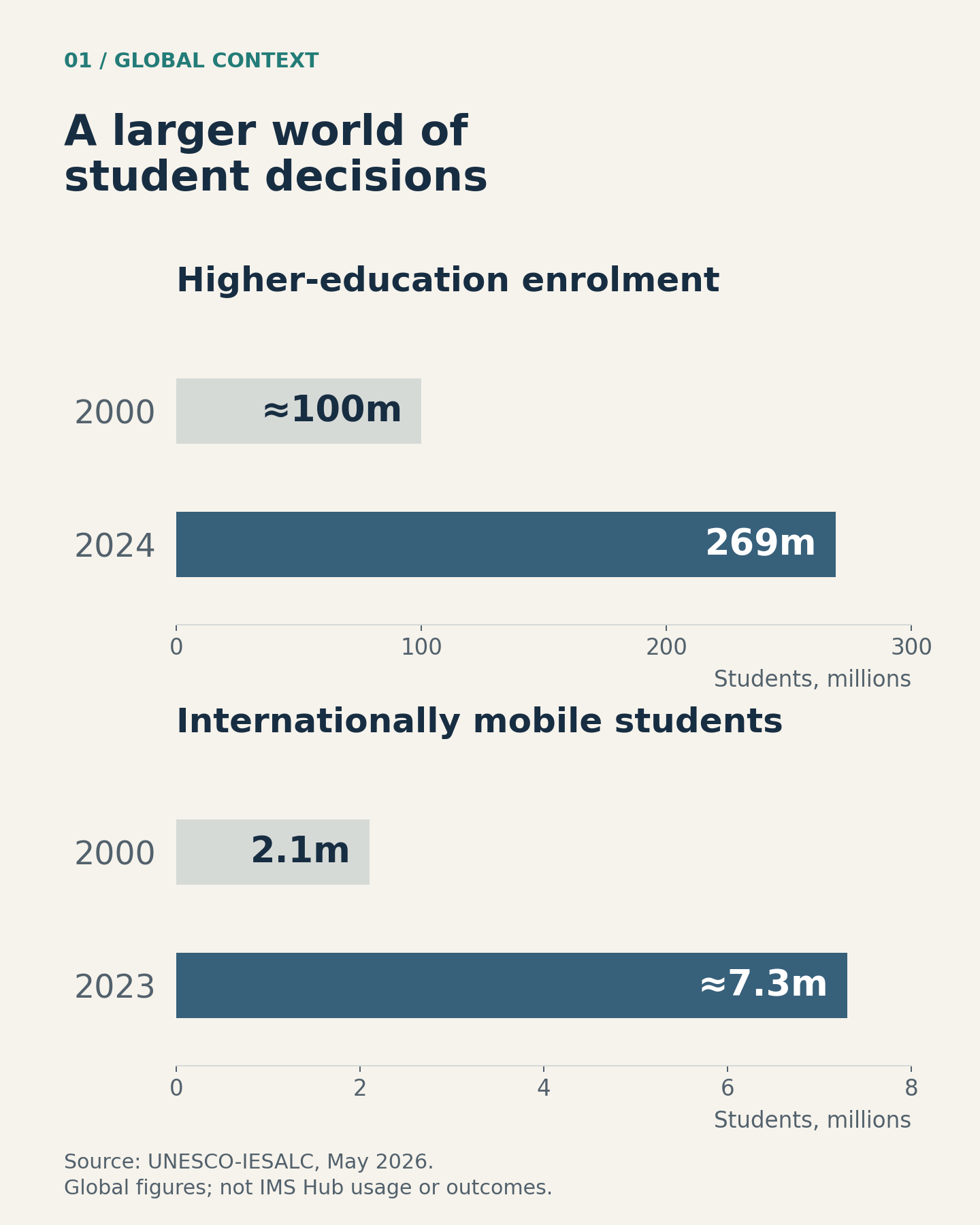
UNESCO-IESALC reports that global higher-education enrolment rose from about 100 million in 2000 to 269 million in 2024. Internationally mobile student numbers increased from 2.1 million in 2000 to nearly 7.3 million in 2023. These are global education figures. Source: UNESCO-IESALC, May 2026.
For an individual student, more choice creates work: interpreting entry requirements, comparing costs, checking funding and understanding life in an unfamiliar place. For universities, reaching a large audience is only useful when prospective students can see how an opportunity relates to their plans.
Academic and Connect solve different parts of the same journey
Academic begins with the student’s situation. The profile brings together personal details, study goals, education history, application readiness, and funding and mobility. That structure gives the search something more useful than a broad question such as “Which university is best?”
A student can describe the subject and qualification they want to pursue, record their grades using their own grading scale, state language evidence, and explain their budget or dependence on a scholarship. With full Academic access, they can investigate university options, read the reasons behind a match, inspect available program and funding information, and save choices worth revisiting.
Connect serves the human side of the journey. Nearby discovery and eligible university communities give students ways to find relevant people. A profile supplies context; an introduction creates a choice; accepted contact sharing makes a conversation possible through the contact methods each person selects.
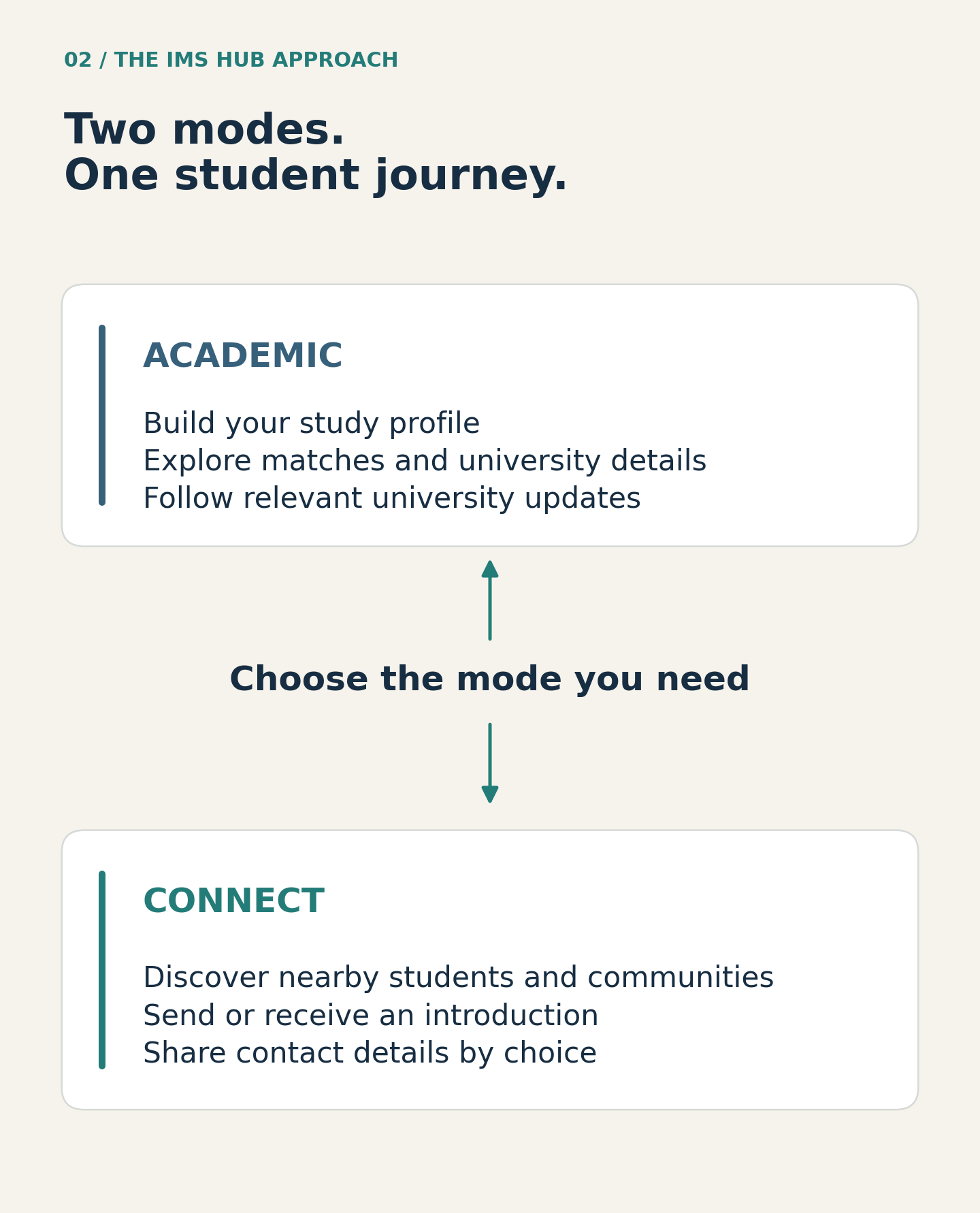
The two modes are useful at different moments. Someone comparing universities may spend more time in Academic. Someone preparing for campus life may turn to Connect. A student already enrolled can continue meeting peers while considering a future qualification. There is no need for every person to follow the same sequence.
Universities can turn relevant information into a conversation
A strong applicant is more than a high grade. A suitable program also depends on preparation, subject interests, qualification level, language requirements, timing and financial feasibility. IMS Hub helps make those considerations visible in the student’s research.
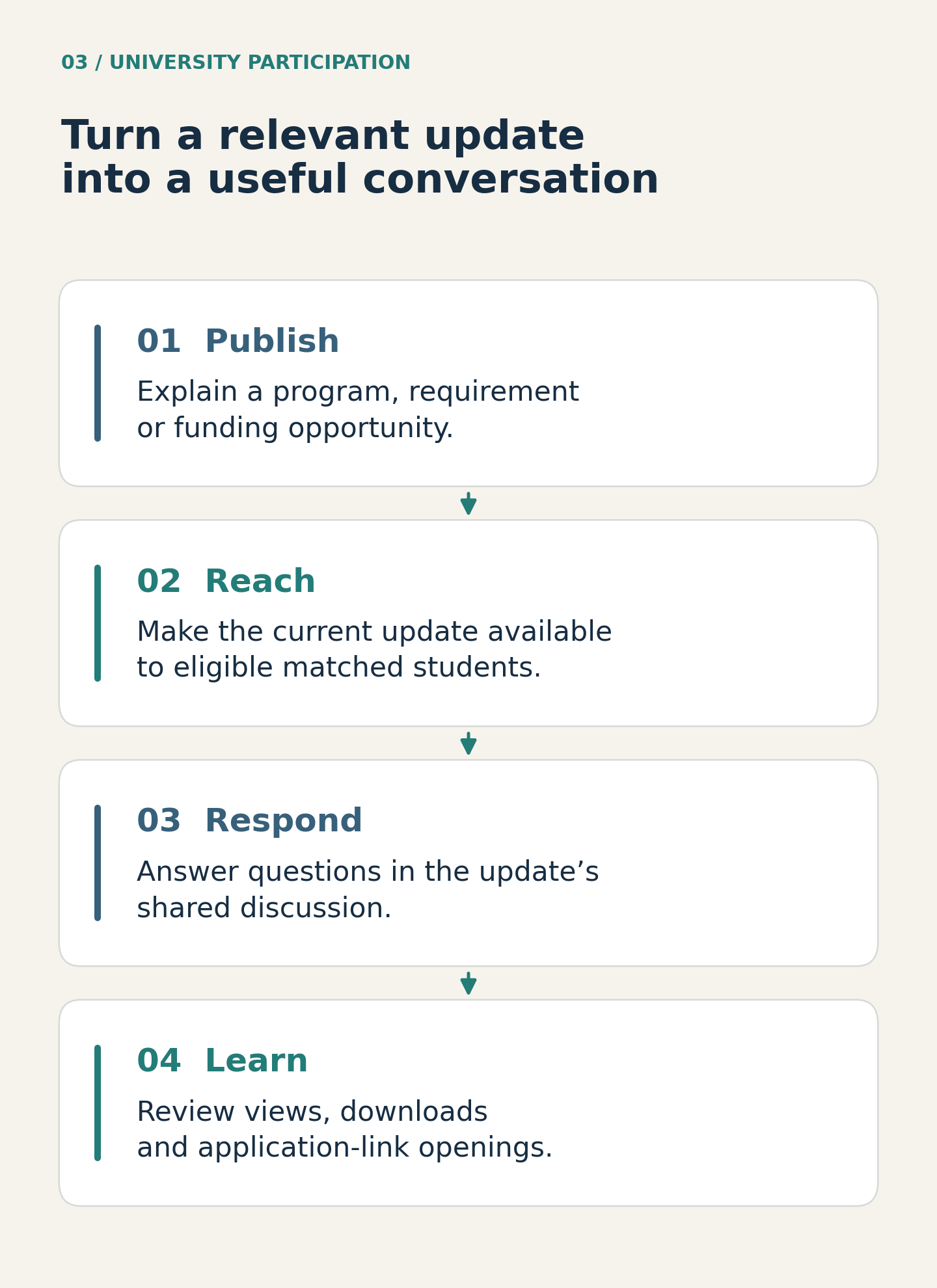
For participating universities, that creates a practical opportunity: explain the institution and its opportunities where relevant students are already investigating them. The university workspace supports publishing updates for matched audiences, responding in shared discussions and reviewing aggregate engagement. Its publishing controls include study-level and audience-language targeting.
A university might explain a program requirement, clarify an intake announcement or publish scholarship information. A student who encounters that update alongside an academic option has context for a more specific question. The institution’s reply can help others reading the same discussion, too.
When an opportunity, its latest update and the university’s answers sit in the same research context, students can focus on what they need to decide next. Eligible readers can learn from an answer already given, and university teams can see which questions need a clearer explanation. This is the practical direction of smarter, faster recruitment: fewer disconnected steps between an initial interest and an informed next action.
The relationship also has a defined privacy boundary. The workspace provides aggregate analytics and shared discussion tools while students’ private profiles, grades, documents and contact details stay private. When students comment, their saved Academic name, nationality and profile photo appear with their contribution. Detailed personal admissions questions belong in the institution’s appropriate private channel.
For students with Core or Pro, eligible posts appear in Academic with their related university information. University replies are visibly distinguished from student comments, and notification controls let students choose when to hear about updates.
Imagine a university publishing an explanation of the language evidence accepted for a particular intake. The following is an illustrative exchange, not a real university announcement:
Student: “I’m still waiting for my language-test result. Which published deadline should I check?”
University: “Please use the intake notice linked in this update. It explains the evidence deadline and the contact channel for individual cases.”
The value lies in the next action: the student knows which source to read and where to ask a private follow-up. The reply remains attached to its context instead of circulating as an isolated screenshot.
University analytics can help staff understand engagement with their information. Staff can review aggregate update views, unique viewers, completed downloads, new saves and Apply-link opens. These represent different kinds of activity: an update view records displayed content, while opening an application link is not proof that a student submitted an application.
How the matching score works
A match percentage is a starting point for investigation. It expresses the current relationship between the saved student profile and available opportunity information. It is not the student’s probability of admission.
The current Academic model uses 13 weighted factors. Academic preparation and program alignment have the largest base weights. Affordability, language, timing and other applicable conditions contribute too, so the result reflects more than subject preference alone.
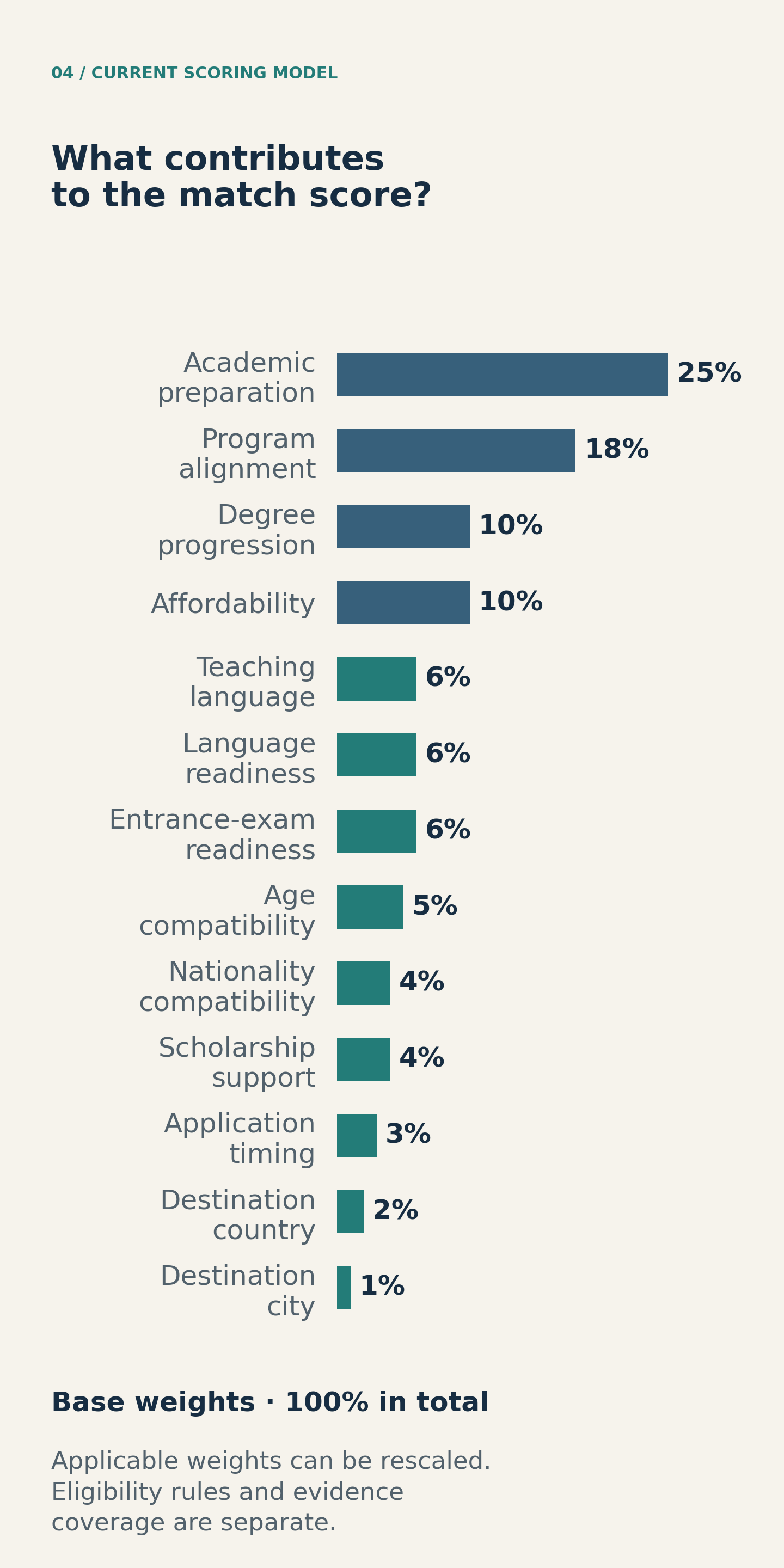
Read the result through three separate questions:
- Fit: How compatible is this option with the student’s current information? Each applicable factor contributes according to its weight and assessed fit. An unknown applicable factor earns no invented fit points.
- Evidence: How well is that assessment supported? Evidence coverage reflects the completeness and quality of the relevant information. It is not the percentage of admission requirements the student has passed.
- Conditions: What still has to be satisfied? A firm eligibility conflict cannot be cancelled by preference points. Pending evidence or requirements can leave an option conditional or provisional.
For example, a preferred destination cannot make an unmet entry requirement disappear. A planned language test does not become an achieved result. Conversely, information that is still missing should prompt a useful question rather than an unsupported conclusion about the student.
The explanation gives a student a practical choice: correct an inaccurate profile detail, investigate a requirement or prepare missing evidence. Your match, available with full Academic access, brings those reasons and assessment details into view. Read the detailed guide to match percentages.
University and scholarship applications need clear routes
Discovery becomes useful when students know how to act on it. In Academic, university details can bring together available programs, fees, accepted grades, requirements, scholarships and application information. The depth of information depends on the published university record.
For an independent applicant, the next steps are practical: check the specific program and intake, inspect the current official requirements, prepare the requested evidence and use the university’s published application destination. When a published application link is available, the Apply action opens that external destination. Saving an option in IMS Hub keeps a research reference; it does not submit an application.
Funding changes whether an attractive option is realistic. Academic can show published scholarship coverage, eligibility, renewal conditions, deadlines and application links alongside cost information. A student’s own contribution to tuition and living costs for the year remains part of that picture. The useful questions become concrete: what would the award cover, what would remain to be paid, and which application route applies? The provider’s current criteria and decisions determine eligibility and awards.
Students who want additional application support can consider Human Admissions Assistance, a separate optional paid service with its own private Applicant File, review process, scope and fees. It is separate from Basic, Core and Pro membership. The university retains its admissions decision. See how Human Admissions Assistance works.
Connect makes the journey more human
Published information can tell a student what a course requires. Another student can offer a personal perspective on settling into a routine, finding a study partner or navigating campus life. Keeping those sources distinct makes both more useful.
Connect starts with a student profile. Eligible students can choose nearby visibility when location permission and discovery conditions allow. University-community discovery requires an approved affiliation in IMS Hub and the student’s opt-in. Choosing a university in Academic does not by itself unlock that community. Students also choose whether their approved institution appears on their profile.
An introduction is an invitation. Before sending or accepting one, each student chooses the contact methods they want to share. Those selected details unlock only after both approve; the recipient can also ignore the request. Supported methods include WhatsApp, WeChat, Instagram and Telegram. Students then continue through the selected external service.
That can make a small but important task easier: finding someone to ask about a shared interest, beginning a language-practice conversation or meeting peers around a university. Availability depends on the people participating; an introduction is not a promise of a reply or an official endorsement of someone’s advice.
Students can stop nearby visibility, manage university-community inclusion, change contact sharing, and use blocking and reporting controls. Revoking contact access stops future access through IMS Hub; it cannot recall details already copied elsewhere. Receiving introductions and using existing mutual contacts remain part of Basic, subject to eligibility, consent and safety rules. Explore the introduction and contact-sharing flow.
What this could change for students and universities
Consider an illustrative student, Amara, exploring a master’s degree. She records her current qualification and grades, preferred field, budget and pending language result. Academic gives her a structured way to investigate options and see which questions remain. An eligible university update clarifies where to check an intake requirement. A Connect introduction gives her a chance to speak with a fellow student about everyday study life. She then chooses an official application route or considers human assistance.
Each step answers a different question. The profile describes her circumstances. Matching helps organise her research. A university supplies relevant information. Another student contributes personal experience. Amara keeps responsibility for the decision and the information she shares.
For universities, the corresponding opportunity is to become more understandable to the right audience: explain program expectations, make funding information clearer, answer recurring questions and learn which information attracts engagement. Institutions with distinctive programs can articulate their fit in the context of a student’s goals.
The opportunity for global education is to make a useful option easier to understand, wherever a student begins. A clear requirement can turn uncertainty into a preparation task. Visible scholarship conditions can turn a funding headline into a realistic plan. A conversation with a peer can help someone imagine daily life in a new place. IMS Hub’s ambition is to connect these moments, with universities explaining what they offer and students choosing with better information.
A practical starting point
For students: build an accurate Academic profile, investigate one university option and identify the question you need to resolve next. Explore Connect when you want to meet people. See what each plan includes.
For universities: begin with the information prospective students repeatedly need. Work with IMS to keep catalog details and application routes current, publish a useful update for the relevant audience and answer the questions it raises. Contact IMS Hub about the university workspace.
The future we are working towards starts with that exchange: a student who understands the next step, a university able to explain why its opportunity fits, and a community that makes the journey easier to navigate.
Explore IMS HubEditorial note: Product descriptions and model weights were reviewed on 20 September 2026. Access depends on the relevant membership, eligibility and regional conditions. The cover is an original AI-generated editorial illustration; the figures explain product concepts and are not app screenshots. The story and exchange are illustrative. Global figures are sourced to UNESCO-IESALC.


